.svg)


.svg)
.svg)

.svg)
.svg)
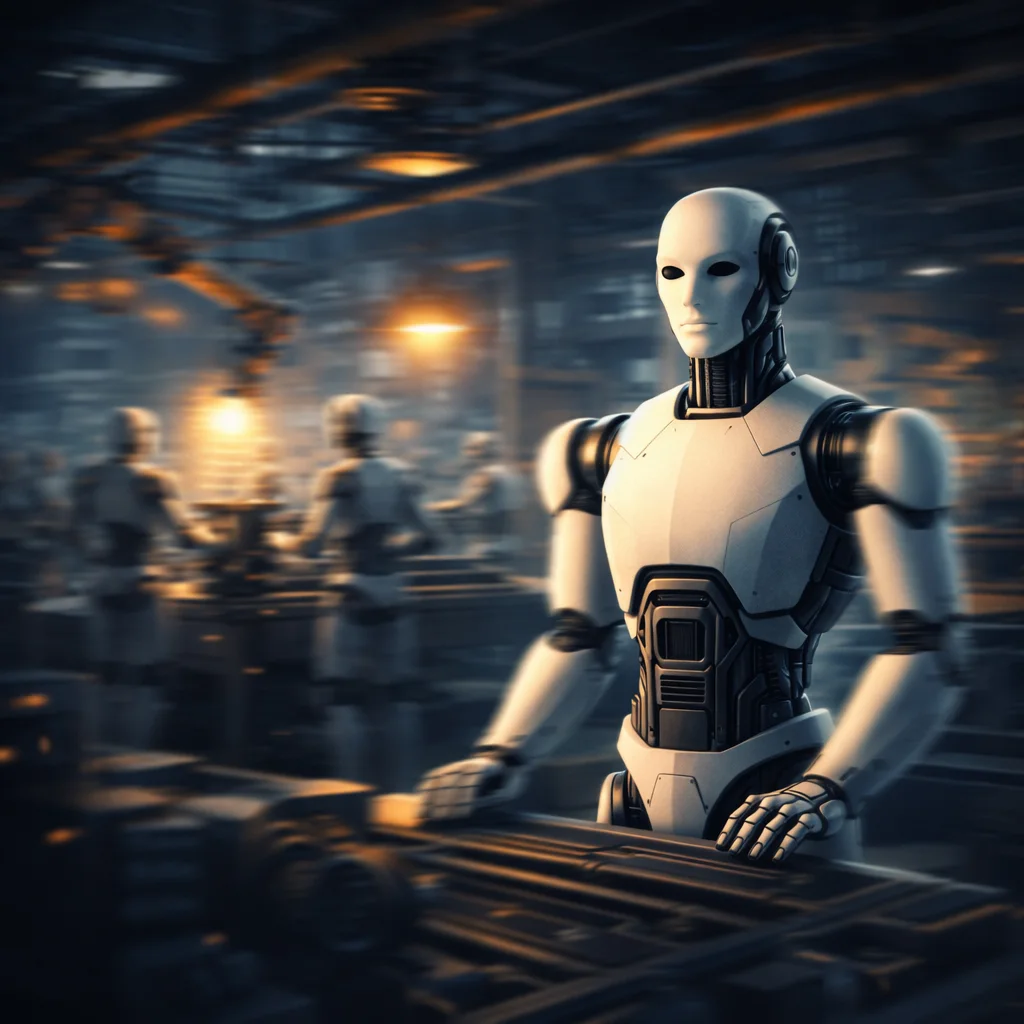
The recent $1bn raise of Figure at a $38bn valuation, an 17x increase in 18 months, highlights the excitement "Humanoids" generate. The amounts raised and the valuation reached contrast with the lack, so far, of large commercial deployment. In this section, we unpack the reasons behind the excitement and suggest a framework to track adoption acceleration.
Many investors question the need for humanoid robots when specialized forms are possible. However, the strongest argument is that the current environment is already "brownfielded" for human anatomy since our world was built by and for humans. This human form factor allows for the seamless integration of robots into existing infrastructure and tasks. Furthermore, the immense variety of tools and machines already designed for human hands can be readily utilized by these robots.
Viewed through the lens of human labor replacement, the Total Addressable Market (TAM) for Humanoids is immense. In the US alone, based on the current employee occupation structure, 60-80m headcounts could be replaced or augmented by humanoids, representing 35-45% of the labor force. Putting the societal backlash aside, at an average wage of $53k, we are talking about a budget of $3.7Tr to go after.
A Humanoid fundamentally requires three key elements: 1) a decision system, 2) a body, 3) a fuel. Each of these has experienced fast improvements in the last 24 months. For the decision system, Large Language Models (LLMs) and Generative AI (GenAI) accelerates how physical machines learn through natural language, imitation, and simulation. This innovation, often driven by multi-modal models (MMMs), allows robots to observe and imitate behaviors in both real and virtual worlds, significantly shortening the R&D cycle.
Although we have seen improvements in the body and the fuel, these depend on atoms rather than digits, which could slow progress of the overall systems. Actuators, the key mechanical part, represent 50-60% of Humanoids Bill of Material (BOM); they are a critical element to innovate on. Battery influence uptime, which in turn impacts the ROI of a Humanoid, and the TAM.
China: Speed and Scale. China is the fastest-moving ecosystem, driven by strong state policy and an agile supplier base. More than 35 new humanoid models launched in 2024 alone. Leading players like UBTech, Fourier Intelligence, and Unitree leverage this model to prioritize rapid iteration and aggressive cost reduction, aiming to shape global standards through sheer scale.
North America: Vertical Integration. North American firms focus on vertical integration and proprietary technology stacks, believing tight ownership of the full system (actuators, control systems, AI) yields superior performance and defensible IP. Tesla (Optimus), Figure AI (piloting at BMW), and Apptronik are developing custom hardware and AI stacks for high-value manufacturing use cases. This approach is slower and more capital-intensive but prioritizes reliable, certifiable robots for complex environments.
Europe: Safety and Trust. Europe is establishing a "trusted humanoid corridor," focusing on safety, compliance, and human-centric design, supported by a strong base of component suppliers. Companies like Neura Robotics (cognitive humanoids), PAL Robotics (proven navigation), and 1X (embodied AI, backed by OpenAI) leverage forthcoming regulatory clarity (e.g., EU AI Act) and emphasize building trust through advanced features like tactile sensing and expressive interaction.
The question is not whether humanoids will matter, but when systems become reliable enough to justify capital at scale. Adoption will lag innovation, then compress quickly once economics and regulation turn decisively favorable.

.svg)
.svg)
.svg)
.svg)
.svg)
.svg)