.svg)


.svg)
.svg)
.svg)
.svg)

Readers keep asking whether we are in an “AI Bubble.” It is the wrong question. AI spending is not binary (bubble / no bubble). It is stratified. At the center sit cash-flow-rich hyperscalers. As you move outward - toward leverage, credit, and speculative balance sheets - risk rises. Hell is not AI itself, but how it is funded.
Hyperscalers are not close to their spending limits. Management teams at Amazon, Meta, Microsoft, and Google have been explicit: they would rather overspend than underspend. Capex growth ultimately depends on revenue expansion, operating cash margins, and the share of cash flow allocated to infrastructure. On these measures, Microsoft alone could plausibly take annual capex to $171bn within three years — roughly 2.5x its trailing pace.
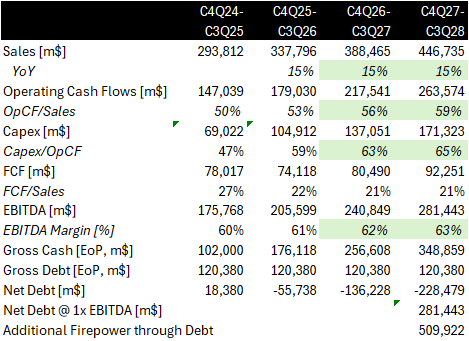
The same pattern holds for Google, Meta, and Amazon. Our framework suggests room for 2.2x, 2.3x, and 1.8x increases respectively. Underlying AI-related capex would grow faster still as other categories are deprioritized. And these numbers rise meaningfully if debt enters the picture: levering each company to just 1x net debt-to-EBITDA would unlock roughly $1.5tr of additional firepower, on top of $1.7tr they can self-fund over three years. At that point, 40–50% annual capex growth becomes achievable.
There are risks to this trajectory. Rising capex suppresses free cash flow growth, the ultimate anchor of valuation. These businesses are becoming more asset-heavy, and ROIC will compress during this investment phase. Yet AI-enabled efficiency gains could lift already-high profitability, expanding the very cash flows that fund the build-out and giving hyperscalers more room to spend or to lever.
Supply constraints are the counterweight. Nvidia and GPUs sit at the receiving end of hyperscaler capex, but the real bottleneck remains TSMC, whose leading-edge fabs are mostly in Taiwan and expanding cautiously. Physical capacity limits are binding. Data centers face their own constraints: record-low vacancy rates, rapid credit-financed build-outs and long lead times for HVAC systems, transformers, turbines and grid upgrades, all of which raise the risk of project delays.
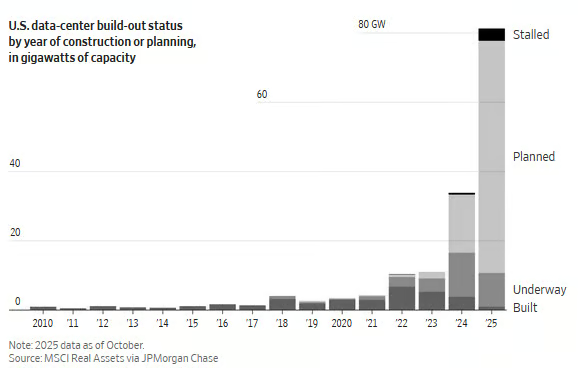
Further away from hyperscaler cash flows, stress is already visible. CoreWeave and Nebius weakened on earnings and debt concerns, while Oracle's shares sold off sharply following heavier-than-expected AI capex guidance. CDS spreads on both CoreWeave and Oracle widened, signaling rising credit risk and growing investor skepticism toward debt-financed AI expansion.
Private markets are the frothier zone. Reflexivity remains high, valuations increasingly reflect capital availability, and funding has concentrated in a handful of investors and assets. Talk of IPOs for OpenAI and Anthropic suggests that private-market liquidity is tightening and that sentiment is beginning to shift.
This is not a broad AI bubble. Risks are concentrated instead in private markets, AI-linked credit, and data-center execution, while GPU supply remains structurally constrained. The hyperscaler spending wave, however, is far from finished.

.svg)
.svg)
.svg)
.svg)
.svg)
.svg)