.svg)


.svg)
.svg)

.svg)
.svg)
The recent SaaS sell-off was not triggered by earnings. It was triggered by a product release from Anthropic.
When Anthropic unveiled Claude Code's expanded autonomous workflow capabilities, public SaaS stocks sold off sharply. Investors interpreted the launch as a credible threat to application-layer incumbents whose value rests on workflow ownership and seat-based pricing. If AI agents can generate code, refactor systems, and orchestrate enterprise tasks natively, the software stack compresses. Multiples adjusted in real time.
The reaction reflects how far Anthropic has evolved from research lab to enterprise platform. As of December 2025, the company reached an estimated ~$9bn annualized revenue run-rate, up more than sevenfold year-over-year, with roughly 80% derived from enterprise customers. In Feb-26, annualized revenue run-rate reached $14bn. This is not experimental revenue. It is production workload.
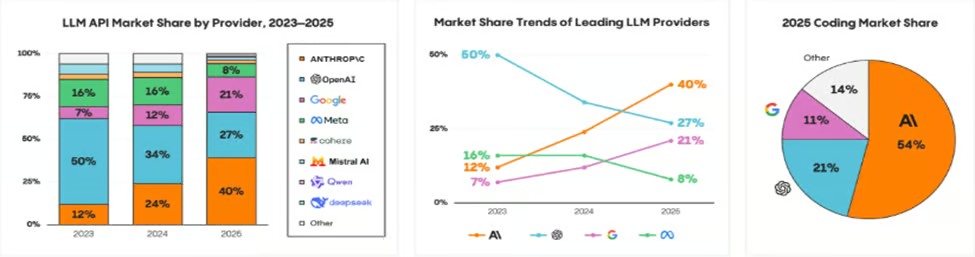
Anthropic's wedge has been coding. Claude Code reportedly commands over 40% share of the commercial coding-agent market, driven by sustained leadership on reasoning and software benchmarks and 18 months atop coding leaderboards. Developers are the earliest adopters of new abstractions. Control the developer workflow, and you influence the enterprise stack.
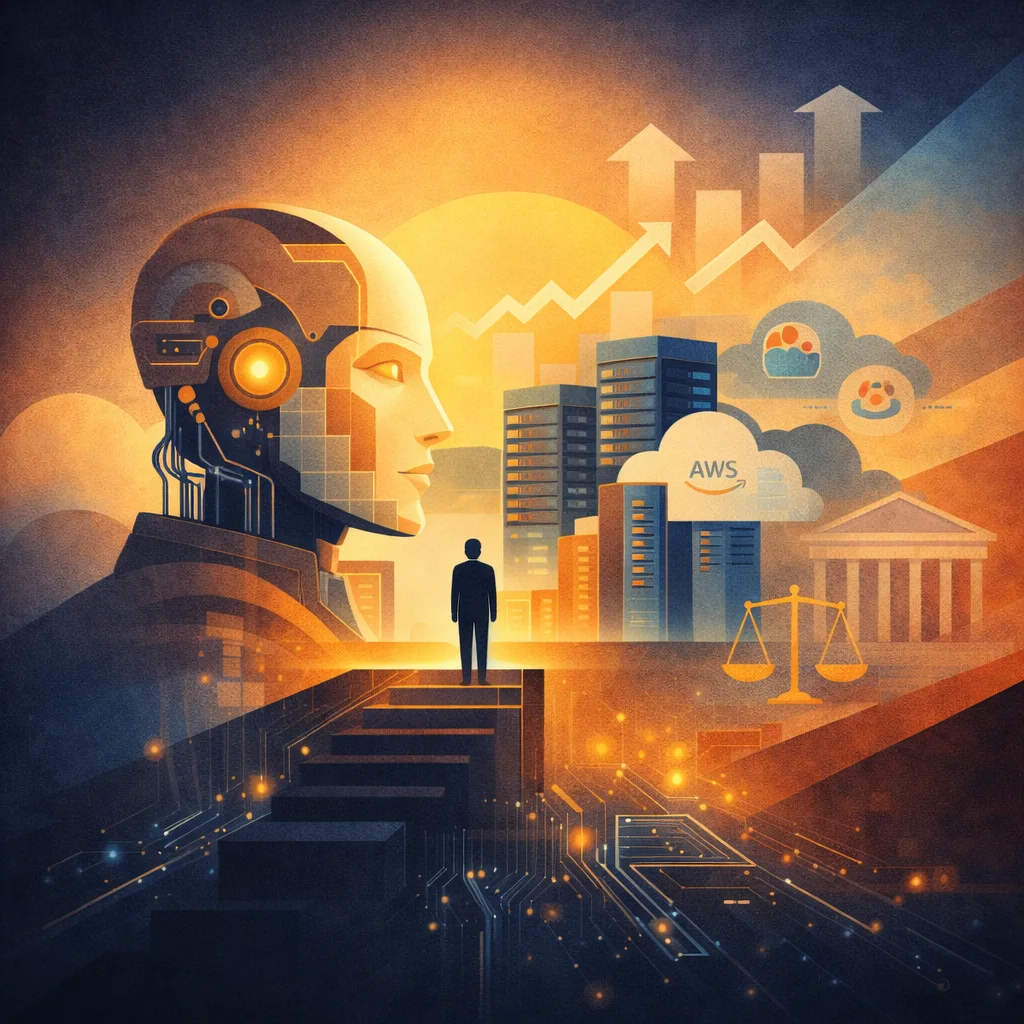
Underneath the product narrative sits infrastructure strategy. Anthropic has secured tens of billions in long-term compute commitments across AWS, Google Cloud, and Azure, while simultaneously investing $50bn into purpose-built data centers and custom silicon optimization. This is vertical integration. As the company invests in its own infrastructure, the business will become more "asset-heavy" but yield higher Gross Margins. Invested Capital will go up, alongside margins. The effect on ROIC remains to be seen; the hope would be that the transitions increase FCF stability, revenue stickiness, and pricing power.
The market increasingly resembles an oligopoly. Anthropic, OpenAI, and Google captured 88% of enterprise foundation-model API share in 2025, up from 70% the prior year. Compute scarcity, hyperscaler alliances, and integration depth favor scale players. Smaller labs risk irrelevance.
Anthropic's differentiation remains governance-first design. Its Constitutional AI framework embeds alignment principles directly into training and post-training, improving predictability in regulated environments. Safety becomes product. In healthcare, finance, and government, that matters.
The valuation, however, demands execution. A ~$380bn price tag implies sustained hypergrowth, gross margins expanding toward software levels, and capex intensity declining as custom silicon improves inference economics. The path exists. It is narrow.

.svg)
.svg)
.svg)
.svg)
.svg)
.svg)